
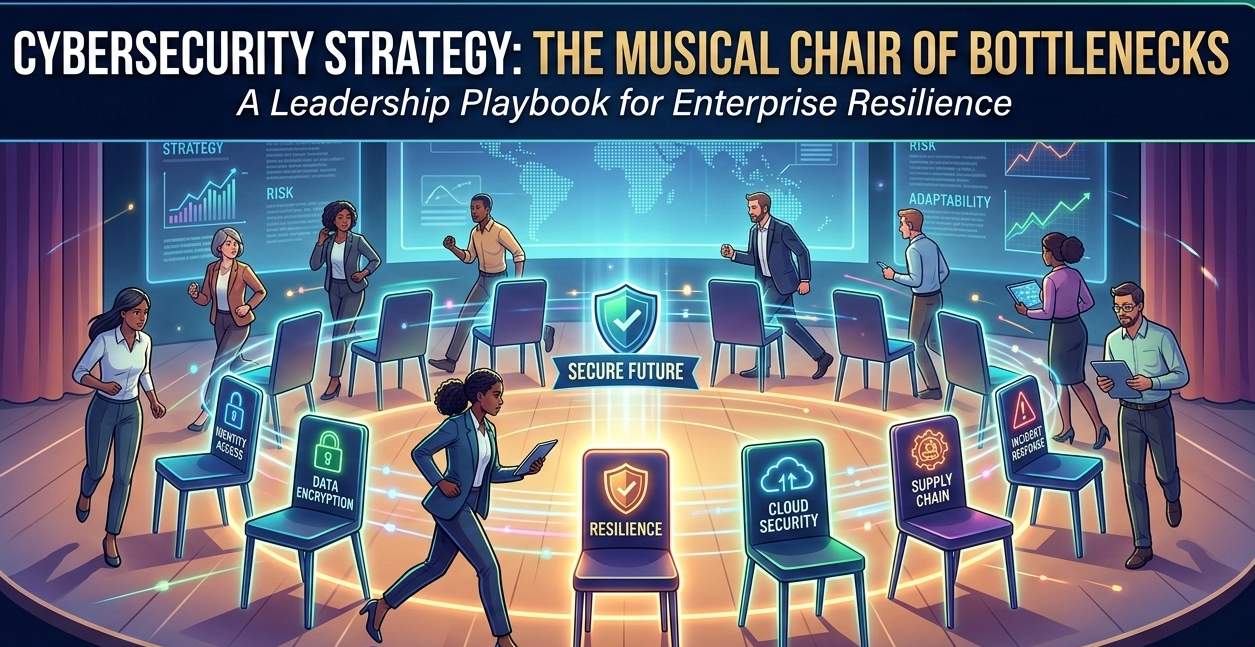
Cybersecurity strategy is often discussed in terms of controls, compliance frameworks, and threat actors. At enterprise scale, however, the defining variable is constraint movement. Every complex system has a bottleneck. In cybersecurity, that bottleneck rarely disappears, it changes location. One quarter it is vulnerability remediation. The next, it is identity sprawl. Soon after, it becomes executive decision latency or third-party enforcement capacity. The mistake leaders make is solving the visible bottleneck while the next structural constraint quietly compounds risk elsewhere. At leadership altitude, cybersecurity is not an operational discipline. It is a systemic one. The role is not to optimize local efficiency but to identify where risk concentration is forming across architecture, governance, capital allocation, and culture. The musical chair analogy is not rhetorical. It is structural reality. And if leadership does not anticipate the next seat, the enterprise absorbs the cost.
Read more: Cybersecurity Strategy: The Musical Chair of Bottleneck- A Leadership Playbook for Enterprise Resilience.Table of Contents
Executive Summary
Cybersecurity strategy at enterprise scale is not constrained by a lack of tools, budget, or talent. It is constrained by shifting bottlenecks. As organizations modernize infrastructure, expand third-party ecosystems, and accelerate automation, risk does not disappear, it relocates. This article examines how cybersecurity bottlenecks migrate across architecture, governance, decision rights, ecosystem enforcement, capital allocation, and culture. It outlines a strategic playbook for SVP Cybersecurity-level leaders to identify structural constraints early, realign incentives, and prevent risk compounding before incidents force reaction. The core argument is simple: cybersecurity maturity is not achieved by operational acceleration alone. It requires systemic constraint recognition and executive-level orchestration.
Tool Velocity vs. Architectural Discipline
A common misdiagnosis in cybersecurity strategy is assuming that red dashboards indicate insufficient tooling. In one enterprise transformation, vulnerability backlog became the visible constraint. Scan results accumulated faster than remediation cycles. The board demanded acceleration. The instinct was to deploy orchestration automation and enhance scanning integration into CI/CD pipelines. Metrics improved. Remediation time dropped. But the bottleneck had already moved. Cloud workloads were expanding without centralized policy enforcement. Third-party APIs were onboarded without risk-tier mapping. Shadow SaaS subscriptions multiplied outside procurement visibility. We had increased throughput inside a system that lacked architectural discipline.
At strategic level, the tension is clear:
- Accelerate detection and remediation capacity.
- Impose governance friction to slow uncontrolled expansion.
The former preserves growth velocity. The latter protects systemic integrity. We reallocated capital away from incremental automation toward centralized cloud governance and third-party onboarding control. Deployment velocity slowed modestly. Structural risk decreased materially. Cybersecurity strategy requires resisting the temptation to optimize symptoms while ignoring expansion physics.
Speed vs. Strategic Friction
Digital enterprises reward speed. Security is often pressured to match it. In one environment, security approvals were delivered within 48 hours to avoid blocking innovation. On paper, it signaled partnership. In practice, design review depth suffered. Six quarters later, duplicated identity repositories, inconsistent encryption key management, and unmanaged service accounts were discovered. No breach occurred. But systemic fragility increased.
The strategic trade-off: (a) Preserve speed and rely on downstream detection. (b) Introduce friction at design stage and absorb political resistance.
We institutionalized structured friction. High-impact initiatives required mandatory threat modeling tied to capital release gates. Security review became a strategic checkpoint, not an operational afterthought. It introduced discomfort. It also prevented compounding architectural risk. At SVP level, leadership must decide where friction belongs. Eliminating friction entirely merely relocates the bottleneck downstream usually into incident response.
Decision Latency as a Strategic Constraint
Not all bottlenecks are technical. In a multi-entity enterprise, incident response delays were traced not to SOC capacity, but to executive indecision. Legal, risk, compliance, and technology debated containment thresholds for every significant alert. The constraint was governance clarity. Hiring more analysts would not solve it. Redesigning decision rights would. We formalized severity tiers with predefined authority delegation. Certain incident classes triggered automatic containment actions without executive approval. Others required structured convening within defined time-frames. Resolution speed improved more from governance redesign than any tooling enhancement. Cybersecurity strategy at senior levels must treat decision architecture as a risk control mechanism
Ecosystem Expansion vs. Enforcement Capacity
Modern enterprises rely on vendors, SaaS platforms, and API integrations. Each partnership expands attack surface. Organizations often scale vendor risk assessments, more questionnaires, more certifications, more due diligence. Yet the bottleneck frequently shifts to enforcement. In one case, vendor onboarding was rigorous. Remediation tracking was not. Contractual leverage was weak. Continuous monitoring was inconsistent.
The tension: (a) Expand ecosystem partnerships to accelerate capability. (b) Constrain ecosystem growth to maintain enforceable oversight.
We introduced tiered vendor classification aligned to data criticality and transaction sensitivity. Procurement KPIs incorporated risk-adjusted onboarding, not just contract speed. Security and procurement incentives were aligned. When growth metrics ignore enforcement capacity, risk accumulates invisibly.
Budget Growth vs. Structural Consolidation
Cybersecurity spending has increased steadily across sectors. Yet risk exposure persists. The pattern: as detection improves, alert volume rises. As alert volume rises, fatigue increases. As fatigue increases, prioritization erodes. The bottleneck moves from detection capability to signal clarity. In one transformation initiative, we mapped overlapping tools across business units. Endpoint redundancy, duplicate cloud monitoring systems, fragmented identity governance complexity masked risk visibility. We consolidated platforms, despite internal resistance. Operational simplicity improved correlation accuracy and reduced alert fatigue. The strategic question is not how much to spend. It is whether capital is reducing systemic fragility or amplifying fragmentation. Cybersecurity strategy must prioritize structural consolidation before incremental expansion.
Cultural Normalization of Risk
The most dangerous bottleneck is cultural. When policy exceptions become routine, audit findings are repeatedly deferred, and security is perceived as an isolated function, risk compounds quietly. We embedded remediation accountability into business unit executive scorecards. Cybersecurity KPIs became shared performance metrics. Behavior shifted. Technical controls matter. But cultural normalization of risk is a slower, more expensive failure mode. At enterprise scale, cybersecurity resilience is inseparable from incentive design.
Forward Horizon: 12-36 Months
Three structural shifts will redefine cybersecurity strategy constraints:
- Identity consolidation will replace perimeter defense as the primary resilience anchor.
- Regulatory convergence will shift bottlenecks toward documentation rigor and interpretation capacity.
- Automation governance will introduce new risk domains around model integrity and decision transparency.
In each case, the pattern remains: bottlenecks relocate. Strategic advantage belongs to leaders who identify constraint migration before incident-driven urgency dictates response.
Disclaimer: This article reflects professional insights derived from publicly available information and anonymized enterprise experience. The views expressed are personal and do not constitute legal, regulatory, financial, or investment advice.