
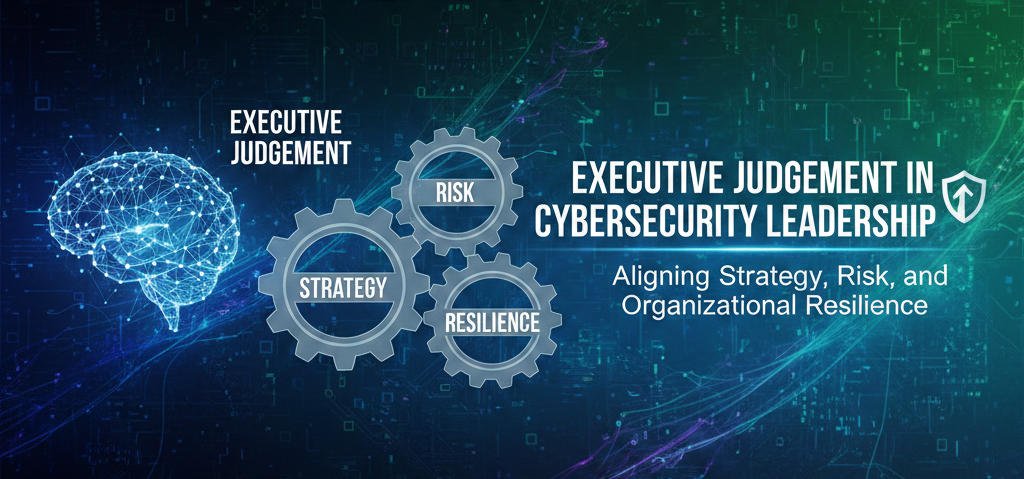
Executive judgement in cybersecurity leadership is the critical differentiator between leaders who merely implement controls and those who shape resilient enterprises. Boards, CEOs, and Chief Information Security Officers (CISOs) face rapidly evolving threats from sophisticated ransomware to systemic supply chain vulnerabilities while balancing operational budgets, regulatory compliance, and business continuity. This article explores how judgement drives strategic trade-offs, integrates threat intelligence with organizational priorities, and fosters enduring cyber resilience. Using real-world, anonymized examples from enterprise cybersecurity programs and critical infrastructure defense, I demonstrate how decisions made today define the organization’s ability to withstand tomorrow’s threats.
Table of Contents
The Foundations of Executive Judgement in Cybersecurity
In cybersecurity, executive judgement is the synthesis of threat intelligence, operational reality, and organizational context. Unlike technology alone, which is deterministic, leadership decisions must weigh uncertainty, risk appetite, and strategic priorities.
For example, during a global enterprise rollout of multi-factor authentication across high-risk user groups, the technical team recommended a phased implementation for operational ease. However, early breach simulations showed critical vulnerabilities in legacy remote access protocols. My judgement was to accelerate deployment despite internal resistance, temporarily overloading helpdesk capacity. The outcome was higher short-term operational friction but avoided a potential compromise that could have cost tens of millions and regulatory scrutiny. This illustrates a core principle: executive judgement trades short-term inconvenience for long-term risk mitigation, anchored in situational awareness and operational insight.
Threat Awareness Meets Business Context
Cybersecurity leaders must translate technical threats into business implications. Boards rarely care about encryption protocols in isolation, they care about financial impact, operational continuity, and reputational risk. Judgement requires seeing both layers simultaneously. A real-world illustration: a multinational manufacturing client faced escalating supply chain attacks targeting third-party software dependencies. Leadership pressure was to block all unvetted vendors, a seemingly safe choice. My judgement, after risk modeling and continuity assessment, was to implement vendor segmentation and enhanced monitoring, rather than blanket restrictions. This preserved production timelines while materially reducing exposure. The trade-off: increased monitoring cost but avoided a potential $20M disruption and client backlash.
In cybersecurity, judgement is always a multi-dimensional trade-off between control, operational feasibility, and business impact.
Risk Prioritization Under Uncertainty
Executive judgement is most visible when allocating scarce resources against infinite threats. Not all vulnerabilities are equal, and not all investments yield proportionate risk reduction. For instance, we had to decide whether to deploy advanced AI-driven threat detection across all endpoints immediately or focus on critical infrastructure. The AI system promised marginally faster detection at high cost. My decision was to prioritize critical servers and sensitive customer data, while monitoring broader endpoints with existing tools. Six months later, a targeted ransomware attack hit a lower-priority segment. Thanks to monitoring and rapid incident response, the impact was contained.
The lesson: Judgement is about optimizing for risk reduction, not chasing perfection.
Ethics and Governance in Cyber Decisions
Cybersecurity leadership is inherently a governance function. Decisions carry legal, regulatory, and reputational weight. For example, during a supply chain breach investigation, a vendor requested delayed disclosure to avoid negative press. The easier path might have been to comply. Judgement dictated immediate disclosure and transparent reporting, protecting stakeholders and reinforcing trust with regulators. The trade-off: short-term reputational pain, long-term credibility gain.
Ethical judgement also shapes security culture. Teams emulate leaders’ decisions whether in disclosure, patch management, or incident escalation. Poor judgement in these areas accelerates systemic risk and undermines resilience.
Team Alignment and Organizational Resilience
Executive judgement extends beyond technical decisions, it is amplified through aligned teams and culture. I have invested in empowering security operations centers to make frontline judgement calls during incidents, supported by clear escalation protocols. This reduces decision latency and prevents single points of failure.
For example, during a multi-region phishing campaign, frontline analysts identified anomalous lateral movement. Empowered by prior guidance and clear decision matrices, they initiated containment without waiting for executive sign-off, saving critical data and mitigating potential breach propagation. My judgement in training and empowerment created a self-reinforcing culture of operational resilience.
Forward-Looking Considerations (12-36 Months)
Looking ahead, cybersecurity leaders will face converging pressures from AI-enabled threats, cloud proliferation, and stricter regulatory frameworks. Judgement must evolve in several ways:
- Strategic Threat Prioritization: Not all alerts are equal. Leaders must focus capital and operational bandwidth on threats with highest business impact.
- Integration of AI and Human Oversight: Automation will scale detection, but human judgement remains essential for context-driven decisions.
- Supply Chain and Third-Party Risk Management: As inter-connectivity grows, leaders must weigh operational dependencies against systemic vulnerabilities.
- Regulatory Alignment vs. Agility: Judgement will increasingly involve balancing compliance adherence with the speed required to innovate securely.
- Leadership Diffusion: Cultivating judgement across teams ensures scalable, distributed decision-making, reducing reliance on single points of expertise.
Those who can operationalize these trade-offs will safeguard both enterprise value and stakeholder trust; those who fail may face cascading impacts from regulatory penalties to systemic operational failure.
In cybersecurity, executive judgement is the fulcrum between resilience and vulnerability. Every decision whether accelerating patch deployment, disclosing an incident, or prioritizing scarce resources carries consequences far beyond the technical domain. Leaders who embed judgement in operational processes, ethical frameworks, and team alignment transform cybersecurity from a cost center into a strategic differentiator.
Ultimately, the question remains: In an era of unprecedented cyber threats, how will your judgement define the resilience and future of your organization? Those willing to embrace disciplined, reflective, and battle-tested decision-making will navigate uncertainty successfully, while those who shortcut judgement will expose themselves and their enterprises to avoidable risk.
Disclaimer: This article is provided for informational purposes only. It does not constitute professional, financial, or legal advice. All examples are anonymized and reflect the author’s professional experience; they do not reference any specific entities. Readers should consult qualified experts for guidance tailored to their circumstances.