



Cyber Governance Drift When Business Runs Security and Security Runs Business

A conceptual banner titled "Cyber Governance Drift," featuring a split-screen design. On the left, a businessman in a suit manages digital security shields and locks. On the right, a tactical security specialist manages business data icons and clouds. Central text reads: "When Business Runs Security and Security Runs Business."

Cyber Governance Drift is becoming a defining risk in modern digital enterprises. It emerges when business executives with limited technical depth begin directing cybersecurity architecture, and when technical security leaders are pushed into commercial decision-making without understanding enterprise risk economics. In high-growth digital environments, this role inversion often appears progressive. Organizations promote cross-functional collaboration, flatten … Read more

Evolving Global Threat Actor Strategies

Digital world map banner with glowing data points and hooded figures representing cyber threat actors. Text reads: "Evolving Global Threat Actor Strategies: Adapting to the New Digital Battlefield."

Threat Actor Strategies Are Outpacing Traditional Defense. Threat actor strategies are no longer limited to opportunistic cybercrime. Today’s adversaries state-sponsored actors, sophisticated criminal networks, and hybrid groups operate with strategic intent, leveraging AI, supply chain access, and persistent multi-stage campaigns. Boards and CISOs face a structural challenge: legacy defenses assume attacks are discrete, IT-centric, and … Read more

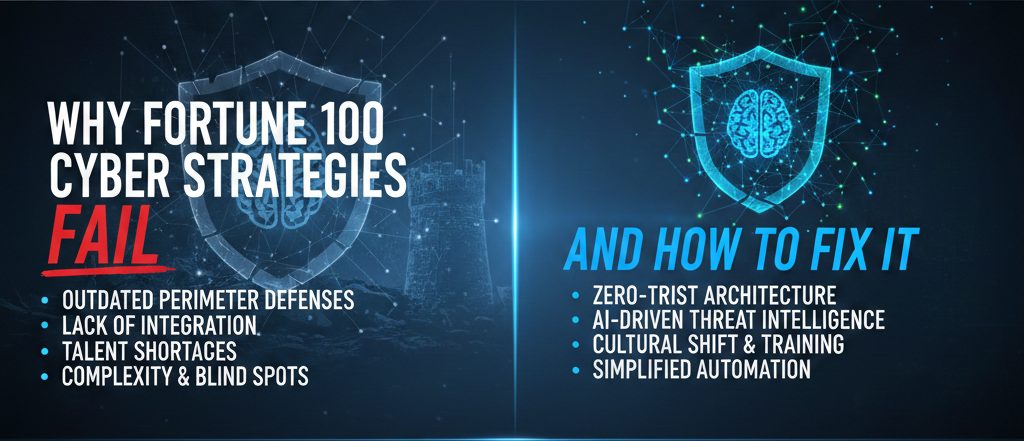
Why Fortune 100 Cyber Strategies Fail at the Board Level and How to Fix It!

Professional cyber security banner titled "Why Fortune 100 Cyber Strategies Fail and How to Fix It," featuring a high-tech blue interface with a digital shield and brain icon, comparing common security failures with modern AI-driven solutions.

Executive Summary In Fortune 100 enterprises, cybersecurity cannot remain a technical silo. It must integrate into capital allocation, risk governance, and value preservation to protect revenue streams, operational continuity, regulatory position, and shareholder trust. Yet structural misalignment persists: boards approve large security budgets while business units push aggressive digital transformation, cloud migrations, and acquisitions with … Read more

Boardroom Cyber Risk Communication & Governance: Strategic Oversight for 2025-27

Corporate board members in a high-rise office discussing cybersecurity risk governance around a table featuring a futuristic blue holographic data interface showing security shields and lock icons.

Boardroom Cyber Risk Communication & Governance is no longer just a compliance checkbox or an IT-only issue. Most boards still underestimate the strategic implications of ransomware sophistication, AI-powered threat detection, and escalating geopolitical cyber tensions. Board-level ignorance can directly translate into financial loss, regulatory penalties, and reputational damage. A recent survey of Fortune 500 companies shows that organizations with structured board-level cyber reporting experience 40-60% faster incident response and 20–30% lower financial impact per event (Directional outcome; no public metric available). Here’s why most boards mis-communicate cyber risk and what elite CISOs deploy instead: frameworks that convert technical complexity into actionable strategic insight, enabling confident, risk-informed board decisions.


Executive Summary

  • Board Cyber Literacy: Most boards underestimate technical cyber risk comprehension.
  • Communication Gap: Operational metrics fail to translate into business impact.
  • Governance Frameworks: ISO, NIST, and SOC2 are necessary but insufficient alone.
  • AI-Enhanced Reporting: Predictive threat dashboards transform executive decision-making.
  • Capital & Risk Alignment: Cyber budget often misaligned with strategic enterprise priorities.
  • Global Proof Points: Elite CISOs use structured board reporting to reduce incident cost and response time.

Read more